
Air Duct Cleaning What It Really Costs: What Portland Homeowners Pay in 2026
Portland homeowners searching for duct cleaning quotes in 2026 will find prices ranging from $89 to over $1,200 for essentially the same stated service. That spread isn’t a market inefficiency. It’s a signal that most of those quotes aren’t describing the same job. A $99 special and an $800 whole-system clean share almost nothing but a name. Understanding what sits between them is the only way to read a quote honestly, and that’s what we’ll walk through here.
What does air duct cleaning actually cost in Portland in 2026?
A legitimate whole-system air duct cleaning in Portland typically runs $450 to $900 for an average home, with larger or more complex systems landing between $800 and $1,200. Those figures reflect genuine professional work: setup, negative-air containment, agitation, extraction, disposal, and access point restoration. Anything below about $300 is almost always a smaller job than the title suggests, and anything above $1,200 usually involves duct repair, multiple zones, or significant accessibility problems.
Here’s the line-item breakdown of what a real job costs to perform in this market:
- Labor: two technicians for three to five hours on a standard single-zone home. This is the single largest cost in any legitimate quote, and it’s the first thing cut when a price drops below $300.
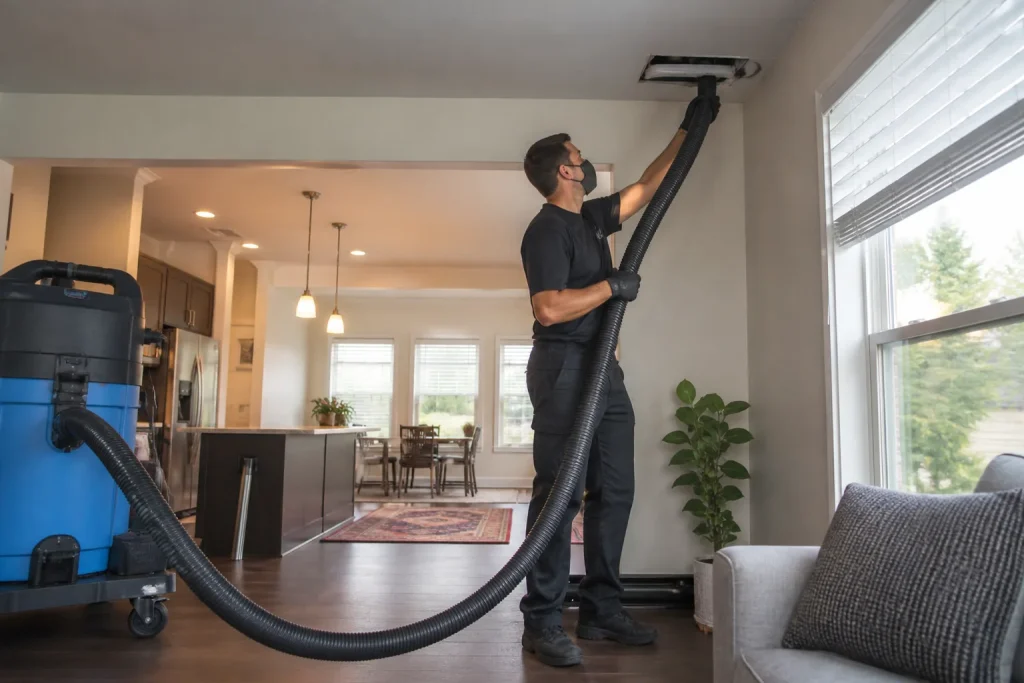
- Equipment operation: running a negative-air extraction unit with HEPA filtration for the full duration of the job, plus the rotary agitation tool. Commercial machines draw serious power and consume filters, and that cost is baked into every honest estimate.
- Containment materials: plastic sheeting, tape, and filter media to seal the work area and capture what gets dislodged. Abatement Technologies filtration equipment is what we use to keep contaminants from recirculating into the living space during the clean.
- Disposal: collected debris has to leave the property and be disposed of properly. It’s not glamorous, but it’s real.
- Access point restoration: cutting and resealing access ports in the ductwork, then reinstalling and sealing register covers. This is where cheap jobs often skip work entirely, leaving holes unsealed or covers loose.
Any quote you receive should be traceable back to something resembling those categories. If it isn’t, ask what’s missing.
Why square footage is the wrong way to price the job
Most consumer-facing pricing tables use square footage, and that’s a poor proxy for job complexity in Portland’s housing stock. A 1,400-square-foot bungalow with original metal trunk lines and easy crawlspace access can take longer to clean properly than a 2,400-square-foot newer home with a straightforward layout. Square footage tells you how much floor you have. It says nothing about how much duct exists, how it’s configured, or how hard it is to reach.
The drivers that actually matter:
- Linear footage of ductwork: a sprawling single-story ranch can hold far more duct than a compact two-story home of the same square footage.
- System configuration: single-zone versus multi-zone systems change the number of runs, the number of access points, and the total time on site.
- Access difficulty: ducts buried in low crawlspaces, behind finished ceilings, or in tight attic runs add hours. Accessibility is the hidden variable in every estimate.
- Age and condition of the system: a system that’s never been cleaned is a different job from one maintained over time.
When you get a quote, ask which of these factors they accounted for. A company that can answer specifically has actually looked at your system. One that multiplies square footage by a rate hasn’t.
The equipment threshold: what separates professional from inadequate
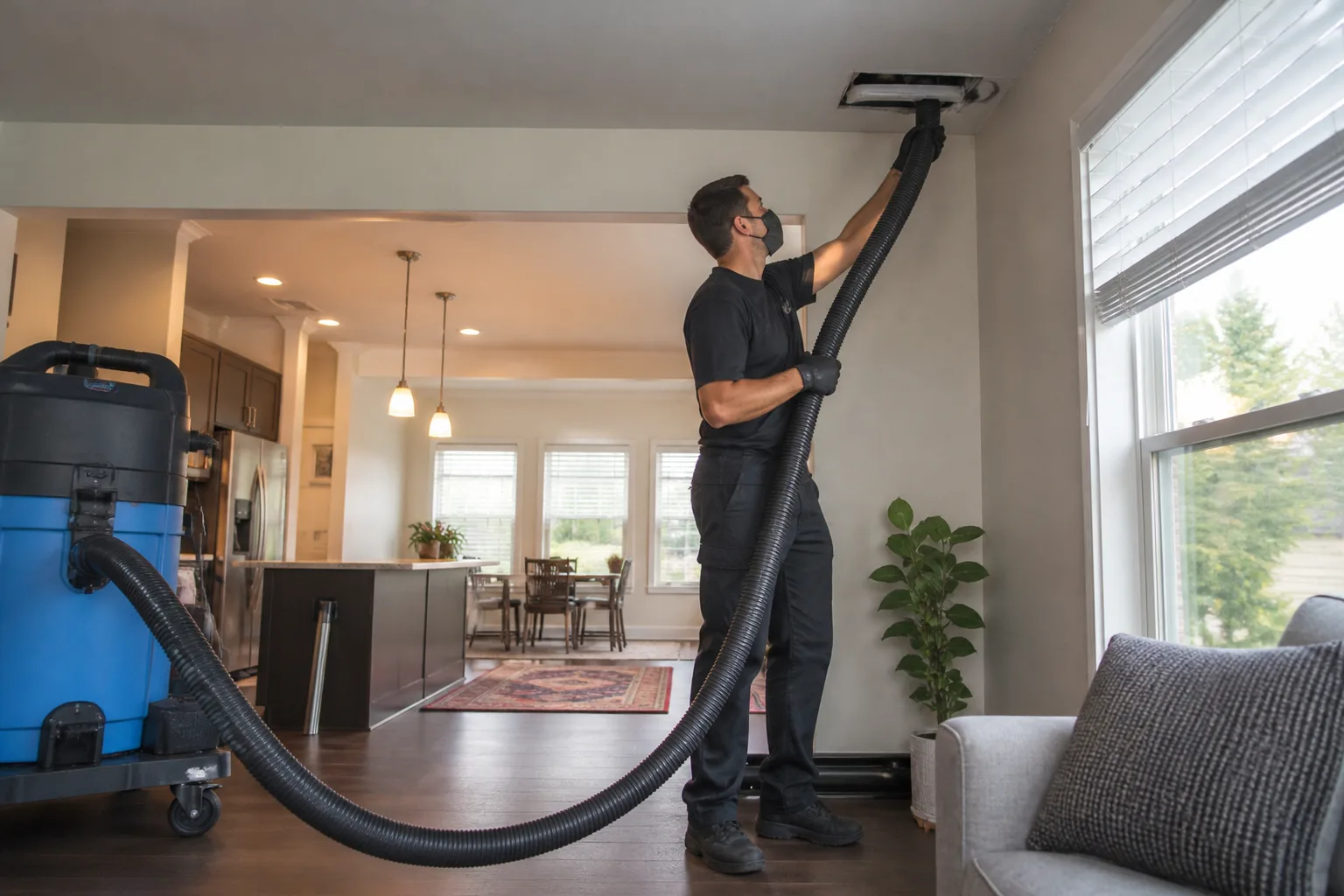
The single clearest line between a real duct cleaning and a surface vacuum is the machine in the truck. A portable shop vac and a commercial negative-air extraction system are not the same animal, and the gap shows in both the price and the result.
Professional systems like Nikro and Rotobrush are built for sustained operation, with high-CFM vacuum, HEPA filtration, and the ability to maintain negative pressure throughout the home while rotary tools agitate debris loose inside the ductwork. They cost thousands of dollars to buy, and a meaningful amount to operate and maintain. That’s why they appear in legitimate five-hundred-dollar jobs and never in ninety-nine-dollar ones.
We use Rotobrush and Nikro systems on every job, alongside Abatement Technologies air filtration equipment to capture what gets dislodged rather than pushing it back into your living room. If a company can’t tell you what machine they’ll bring, what its filtration rating is, and how they’ll maintain negative pressure during the clean, the price they quoted probably tells you the answer. Our technicians have up to 8 years of experience, and they can walk you through the setup before any work begins.
Which add-ons are legitimate and which are upsells?
Not every add-on on an invoice is a scam, but some clearly deliver more than others. Here’s how to tell the difference before you sign:
Worth considering
- Dryer vent cleaning: a genuine service with a documented safety rationale. The NFPA cites lint buildup as a leading cause of residential fires, and a clogged dryer vent is a fire hazard, not just an efficiency problem. Pairing it with duct cleaning is often practical. Our dryer vent cleaning is a standalone service for exactly this reason.
- Duct sealing and repair: if the inspection found disconnected joints, crushed flex runs, or holes in the trunk line, sealing and patching is real work with a real return. We treat air duct cleaning and duct repair as separate but often related jobs.
- Sanitizer application: legitimate when there’s an actual reason (odor, microbial growth visible on inspection), less so as an automatic line item on every quote.
Skip unless justified on inspection
- Fogging treatments sold without a specific finding, and re-cleaning packages pushed on a schedule unrelated to your system’s condition.
- Filters sold at a markup you can buy yourself.
- Air quality add-ons that don’t reference your existing system. If you have a Honeywell or Aprilaire setup, ask how the proposed work interacts with it rather than accepting a generic add-on.
What Portland’s older housing stock adds to the scope
Portland’s pre-1980 homes bring their own complications to a duct cleaning job. Original flexible duct that’s been in place for decades may be deteriorating from the inside, and cleaning without inspection can dislodge material that should have been replaced. Metal trunk lines from the same era are often well-built but frequently leak, having loosened at the joints over many decades. And access is the recurring theme: crawlspaces, retrofitted systems, and ductwork squeezed into spaces the original builders didn’t plan around.
That’s why age of the system is a better cost predictor than home size in Portland. A 1950s home with original flex runs will usually require inspection, careful handling, and possibly duct repair on top of cleaning. A 2010 build with clean, accessible flex will typically cost less to service properly. Knowing what you’re working with before the estimate arrives changes the number you should expect.
When to call a pro
If you’re seeing visible dust streaming from registers after a cleaning, hearing whistling at vents, noticing uneven airflow between rooms, or dealing with allergy symptoms that seem tied to HVAC operation, those are signs the job needs more than a vacuum. Duct damage and system-level issues are difficult to assess without the inspection tools and equipment a professional brings. The same goes for any dryer vent that hasn’t been cleaned in years and takes more than one cycle to dry a load.
Related services in Portland
We work across Portland on air duct cleaning, dryer vent cleaning, and duct repair. If your existing system includes a Honeywell or Aprilaire whole-home air quality component, or a Guardsman filter setup, we can put the duct work in context with the rest of the system rather than treating it in isolation. For background on who we are, see Steadfast Air Duct Cleaning.
The Bottom Line
The gap between an $89 special and a $750 legitimate job isn’t inflation or greed. It’s the difference between a portable vacuum and a professional negative-air extraction system, between a quick pass and a full diagnostic clean with containment, and between a company that shows up and a company that finishes the job. When you audit a quote, look for labor hours, equipment specifications, containment materials, disposal, and access point restoration. If most of those are missing, the price is missing something too.
We give one flat price per system agreed before work starts, use professional-grade equipment on every job, and provide before-and-after photos of your own ducts. If you’re in Portland and need help, Steadfast Air Duct Cleaning offers free estimates. Call (877) 957-0767. We answer 24/7. Fast dispatch from 7am to 7pm, Sunday through Friday.
Frequently Asked Questions
Most Portland homeowners pay $450 to $900 for a legitimate whole-system cleaning in 2026, with larger or more complex systems reaching $800 to $1,200. Anything below $300 is usually a smaller service than the name suggests. Call (877) 957-0767 for an exact quote on your system; estimates are free.
Cheap quotes usually skip the expensive parts: negative-air containment equipment, adequate labor hours, disposal, and access point restoration. A $99 job is often a surface pass with a portable vacuum that moves dust around rather than removing it. A quote that can’t explain its line items probably isn’t performing them. Call (877) 957-0767 to walk through what a legitimate job includes.
Ask for before-and-after photos of your own ductwork, and ask the technician to walk you through what they found and where. A company that documents its work has nothing to hide. A company that discourages inspection has plenty. When you call (877) 957-0767, we’ll explain exactly what will be photographed and reported.
Most homes benefit from a professional cleaning every three to five years, though homes with pets, recent renovations, or allergy concerns may need it more often. Homes with original ductwork that’s never been serviced should be inspected first. If you’re unsure, call (877) 957-0767 and we’ll help you decide based on your system, not a sales schedule.
Written by the team at Steadfast Air Duct Cleaning.
Need Air Duct Cleaning Help?
Call Steadfast Air Duct Cleaning - licensed & insured, with free written estimates in Portland.
(877) 957-0767