
Emergency Air Duct Cleaning Near Me: What Portland Homeowners Should Do First
If your home has just had a fire, a flood, a rodent problem, or major construction, don’t run the HVAC system until the ductwork has been inspected and isolated. The first move in a real duct emergency is almost always to shut the system off and leave it off, then call for an inspection before a single register gets vacuumed. If you’d rather not sort through that on your own while the house is still in chaos, call (877) 957-0767 and we’ll walk you through the first steps.
What actually counts as a duct emergency in Portland?
Four situations qualify as genuine duct emergencies in Portland homes: post-fire smoke contamination, post-flood moisture and microbial risk, rodent or bird intrusion with nesting material, and construction debris pulled into the system during a remodel. Each one sends something into the ducts that doesn’t belong there and spreads every time the blower runs. The house doesn’t have to look damaged for this to be true. Smoke particulate and fine dust travel the whole trunk-and-branch layout within a few cycles, closing bedroom doors or not.
Portland’s wet half of the year is what makes the flood and moisture scenario so common. Ductwork that runs through crawlspaces and garages picks up damp air fast during a long rainy stretch, and any insulation inside those runs that has gotten wet stays wet. That’s a different problem from a clogged filter, and a standard vacuum-and-go visit won’t solve it. Rodent intrusion also picks up in older neighborhoods around the fall, when mice and rats look for warmth. Nesting material inside a duct is a fire risk as well as an air quality problem, which is why we treat it as urgent rather than “get to it eventually.”
If you’re not sure which category your situation falls into, that’s normal. Most people aren’t. The inspection is what sorts it out.
What should you do first, by scenario?
The correct first move depends entirely on what happened. Here’s the sequence for each, and in every case the HVAC system stays off until an inspection is complete.
- After a fire. Turn the system off at the thermostat, then at the breaker if you can reach it safely. Don’t run fans to “air things out” if those fans push air through the ducts. Soot and char particles are fine enough to ride the airstream into rooms that never saw flame. Leave windows open for ventilation but keep the HVAC out of the equation until the ductwork is isolated.
- After a flood or water intrusion. Shut the system off. Don’t run it to “dry things out” – that’s the instinct that causes the most trouble here. Moving air through wet duct lining spreads moisture into sections that were dry. Get standing water out of the home, then have the ductwork inspected before the system runs again.
- Rodent or bird intrusion. Shut the system off. Don’t vacuum the register openings yourself – a shop vac will blow fine debris and droppings back into the room. Trapping or removing the animal comes first, then the cleaning and any damaged section of duct gets repaired.
- Construction debris. Shut the system off and keep register openings covered while work continues. Drywall dust and sawdust pulled into the return will coat the inside of the whole system. Covering registers during a remodel is the cheapest prevention there is.
If you’re ever unsure, the safe answer is off. We’d rather inspect a system that was never run than clean one that already spread contamination.
How do you document duct damage for an insurance claim?
Document the duct condition before any cleaning begins: photos of each register and return as found, photos inside accessible duct runs, a timestamp on every image, and a written assessment from a professional describing what’s there and what caused it. Most carriers want the condition documented in place, not after the ducts are clean, because the before-and-after comparison is what supports the claim. Once cleaning starts, the evidence is gone.
In our experience, homeowners who call a cleaning company first and their insurer second are the ones who have the hardest time. Flip that order. Everything you photograph for yourself also helps the adjuster, and it helps the duct professional write a clearer assessment of whether the system needs cleaning, repair, or both. We’re happy to work with your insurer and provide that written assessment – that’s part of a serious emergency response, not an upsell.
What carriers typically want to see:
- Photos taken before anything is moved or cleaned, with the date and time visible.
- Photos inside accessible duct sections, not just at the grilles.
- A written professional assessment that names the contamination source and the affected areas.
- Before-and-after photos of the same locations once work is complete.
Why does emergency duct work often need repair, not just cleaning?
Real duct emergencies usually damage the ductwork itself, not just its contents. Heat can warp or separate flexible duct sections after a fire. Water can degrade the internal lining so it sags or crumbles. Rodents chew through flex duct and insulation. In each case, cleaning alone leaves a compromised system that will keep leaking air into the home or pulling contaminated air from a crawlspace.
That’s why we offer air duct cleaning and air duct repair as separate, standalone services – we can clean, then seal, patch, or replace the compromised section in the same visit. A cleaning-only operator will clean around the damage and leave the gap. When you’re calling around after a fire or a flood, ask one direct question: can you repair the ductwork, or just clean it? The answer tells you what kind of company you’re talking to. If the answer is “just clean it,” keep looking.
If you’d rather start with an inspection than guess, that’s the right order, and we’ll tell you honestly whether repair is needed.
What does Abatement Technologies HEPA equipment actually do differently?
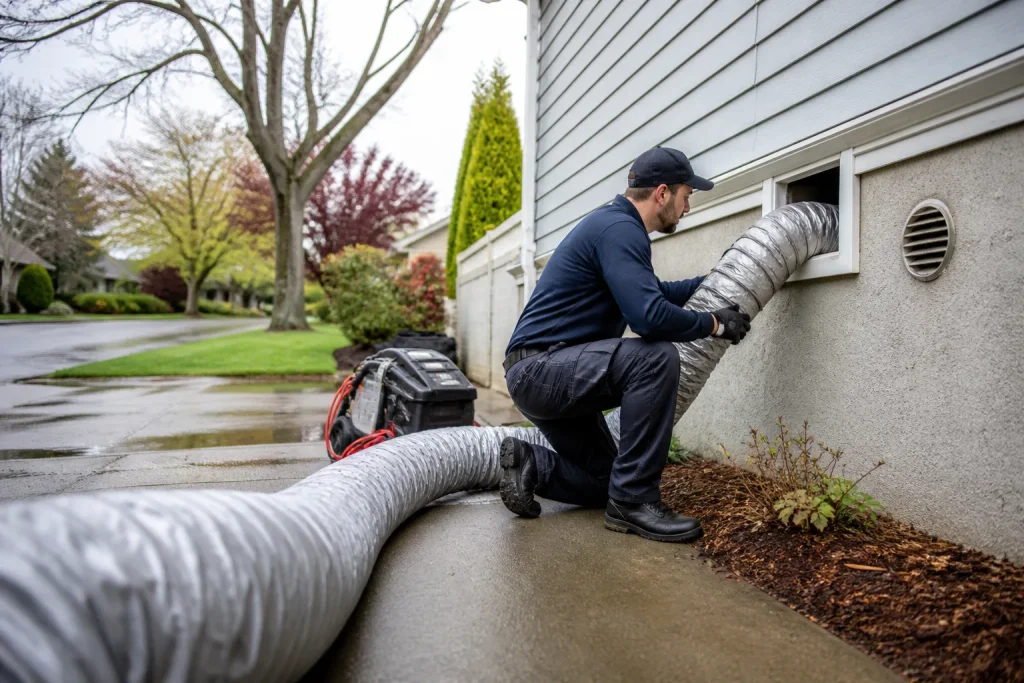
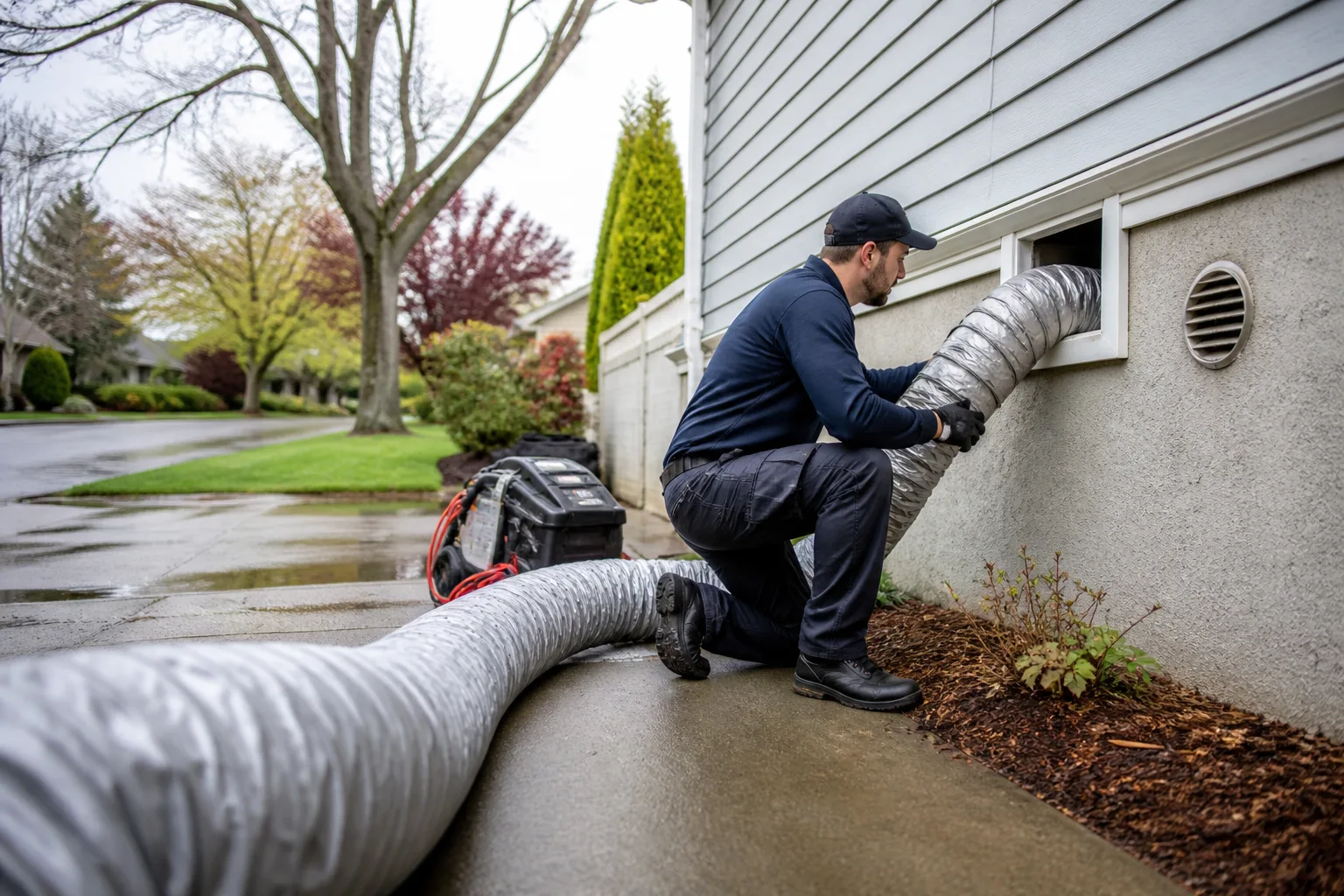
Abatement Technologies HEPA extraction is built to contain contaminants inside the system while they’re being removed, not to recirculate them into the room. In a contamination job, the equipment runs as a negative-air setup: it holds the work zone at slightly lower pressure than the surrounding rooms, so air from the affected space flows toward the equipment instead of into your kitchen. That’s the difference between a cleaning and a decontamination. It’s also why a fire or flood response needs more than a shop vac and a positive attitude.
We run Rotobrush and Nikro systems on every job, plus Abatement Technologies air filtration to capture what the brushes and whips dislodge. In a normal cleaning that matters. In a post-fire or post-flood job it’s the whole ballgame, because dislodged soot or dried microbial material that escapes the extraction zone just resettles in another room. Negative-air containment keeps the work inside one boundary. But no equipment replaces the professional judgment of when to shut the system down and leave it down – that call comes first.
If you have a Honeywell or Aprilaire whole-home air quality system, we can also place the duct work in context with the filtration and humidity control you already have, so the cleanup accounts for the whole picture rather than one component of it.
One small note: a homeowner holding a flashlight inside a register at 11 p.m. is a familiar sight, and we understand the impulse. Waiting until daylight to call is still the right move.
When should you call a pro instead of handling it yourself?
Call a professional immediately for any of the four emergency scenarios above – fire, flood, rodent intrusion, or construction debris. Inside a duct system, contamination spreads through pressure changes you can’t see, and consumer vacuums, blowers, and shop vacs make it worse. That’s not a sales pitch, it’s a physics problem. High-tension components, wet duct lining, and confined crawlspace work all carry real risk of injury or damage if handled without the right equipment. A trained professional is the right call.
For everyday duct maintenance, a professional inspection every few years is plenty for most homes, and a homeowner can handle filter changes in between. The emergency list is different. If you’re in Portland and want a real assessment, call (877) 957-0767. We answer 24/7. Fast dispatch from 7am to 7pm, Sunday through Friday. Estimates are free, and the price is set per job by a written estimate before work starts.
Related services in Portland: dryer vent cleaning is worth doing at the same time as an emergency duct job. A clogged dryer vent is a documented fire risk that most duct cleaners treat as an afterthought, and if your home just had a close call, checking it while we’re there makes sense.
The Bottom Line
The single most important thing in a duct emergency is shutting the HVAC system off and leaving it off until a professional inspects and isolates the ductwork. Document everything before any cleaning begins, and keep the order straight: photos, insurer, then cleaning. Real emergencies – fire, flood, rodent intrusion, construction debris – almost always need repair alongside cleaning, not just a vacuum. Negative-air HEPA extraction is what separates a proper contamination response from a standard clean. If you’re in Portland and need help, Steadfast Air Duct Cleaning offers free estimates – call (877) 957-0767. We answer 24/7, with fast dispatch from 7am to 7pm, Sunday through Friday. We use Rotobrush and Nikro equipment and repair the ductwork we find damaged, so the fix matches the problem.
Frequently Asked Questions
Most duct cleaning in Portland falls in a typical range of $350 to $900 for a whole system, and repair work or contamination scenarios with duct section replacement usually land higher, in the $900 to $2,500 range, depending on how much ductwork needs work. These are typical estimates, not exact quotes – the written estimate sets the final price. Call (877) 957-0767 for an exact quote – estimates are free.
No. Running the system after a fire is one of the fastest ways to push smoke particulate and char into rooms that weren’t directly affected. Shut it off at the thermostat and leave it off until the ductwork has been inspected. That single step protects more of your home than anything else you can do in the first hours.
You need an inspection to know for certain. Heat, water, and rodents can damage duct lining and seams in ways you can’t see from a register. That’s why we offer air duct repair as a standalone service – some systems only need cleaning, and some need a section sealed or replaced first. An honest inspection tells you which one you’re facing.
We answer 24/7. A call outside dispatch hours is booked into the next opening, Sunday through Friday, 7am to 7pm. If your system has already been shut off and the situation is stable, that’s a safe way to wait.
Cleaning before documenting can make a claim harder, because the evidence is gone. Photograph everything as found, get a written professional assessment, then clean. We can work with your insurer and provide the before-and-after photos carriers need to process the claim.
For a free estimate anywhere in the area, call (877) 957-0767. We answer 24/7. Fast dispatch from 7am to 7pm, Sunday through Friday. Estimates are free, the price is set per job by the written estimate, and you’ll get before-and-after photos of your own ducts when the work is done. If you’re not sure whether your situation is a true emergency, call anyway – a quick conversation is often enough to tell.
Written by the team at Steadfast Air Duct Cleaning.
Need Air Duct Cleaning Help?
Call Steadfast Air Duct Cleaning - licensed & insured, with free written estimates in Portland.
(877) 957-0767